A few weeks before InfoComm 2026, I wrote about the five questions I expected to hear on the show floor in Las Vegas. I've now had those conversations – and hundreds more - and many of my predictions did indeed hold up. A few played out differently than I expected, and one topic I didn't predict at all turned out to be the biggest story at our booth.
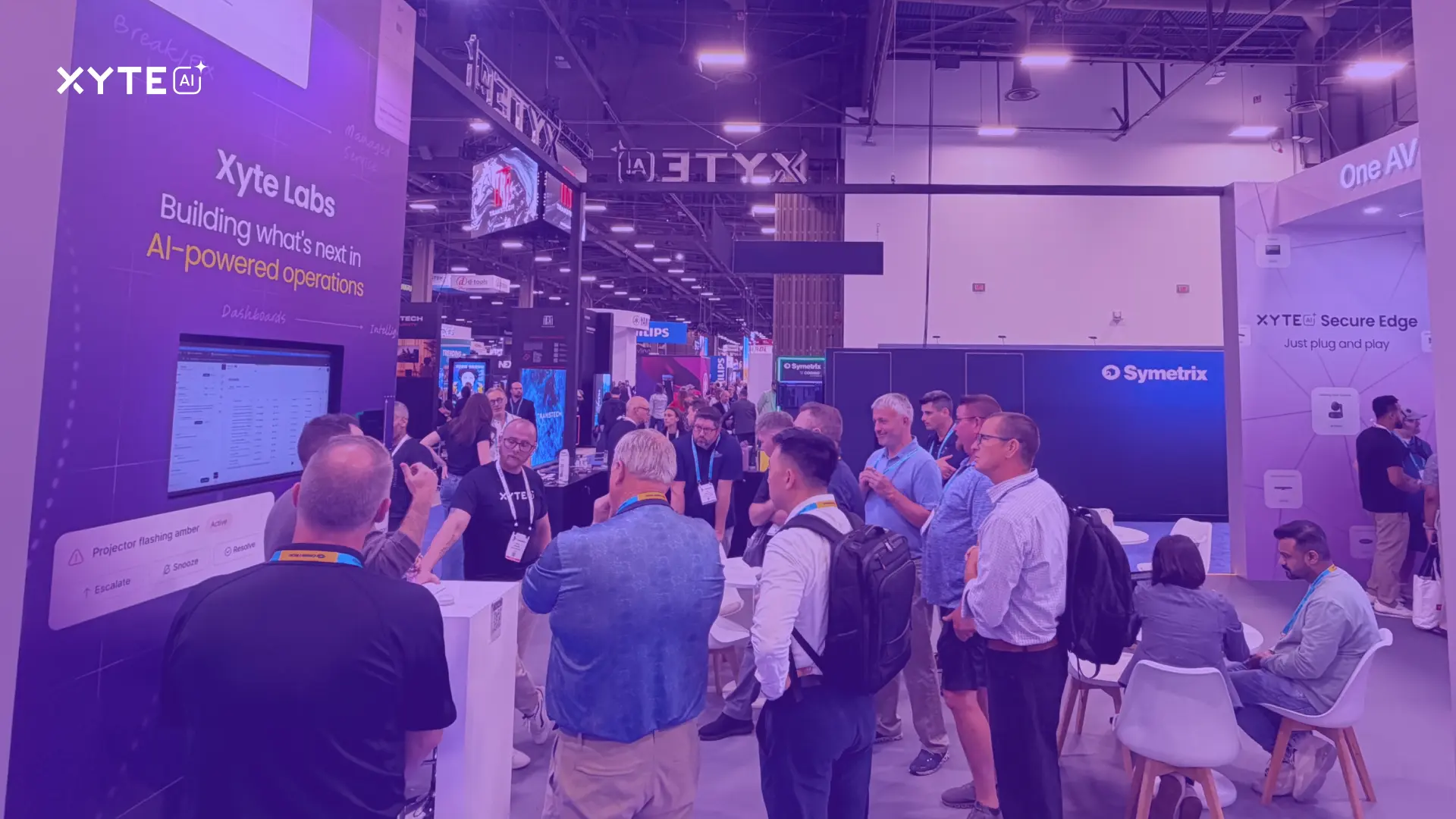
Attendance seemed lower at InfoComm this year, perhaps due to rising travel costs. But there were booths that drew consistent crowds all week (like Xyte's). And these had one thing in common: they were showing what their AI actually does - and people were lining up to see it.
In this blog, I'll walk through what I saw, what surprised me, and where I think the industry is heading based on three days of unfiltered conversations in Las Vegas with integrators, IT leads, and enterprise AV teams.
AI Moved from Buzzword to Proof
Every year at InfoComm, there's a theme that pops up in almost every conversation. Last year, it was “AI.” People wanted to be sure a platform was using AI. This year, the market is more mature – people wanted proof. They wanted to see what AI does, right there at the booth, in a live demo. The vendors who could show specific outcomes - room auto-tuning, intelligent diagnostics, guided remediation - had people standing three deep. The ones still talking in generalities about AI...had open carpet in front of them.
At our booth, visitors were asking how Xyte identifies root causes, how it summarizes incidents, and how it helps a team of five people manage 5,000 rooms. Nearly every one of these conversations ended with a request for a live demo.
CLI Was the Surprise Hit
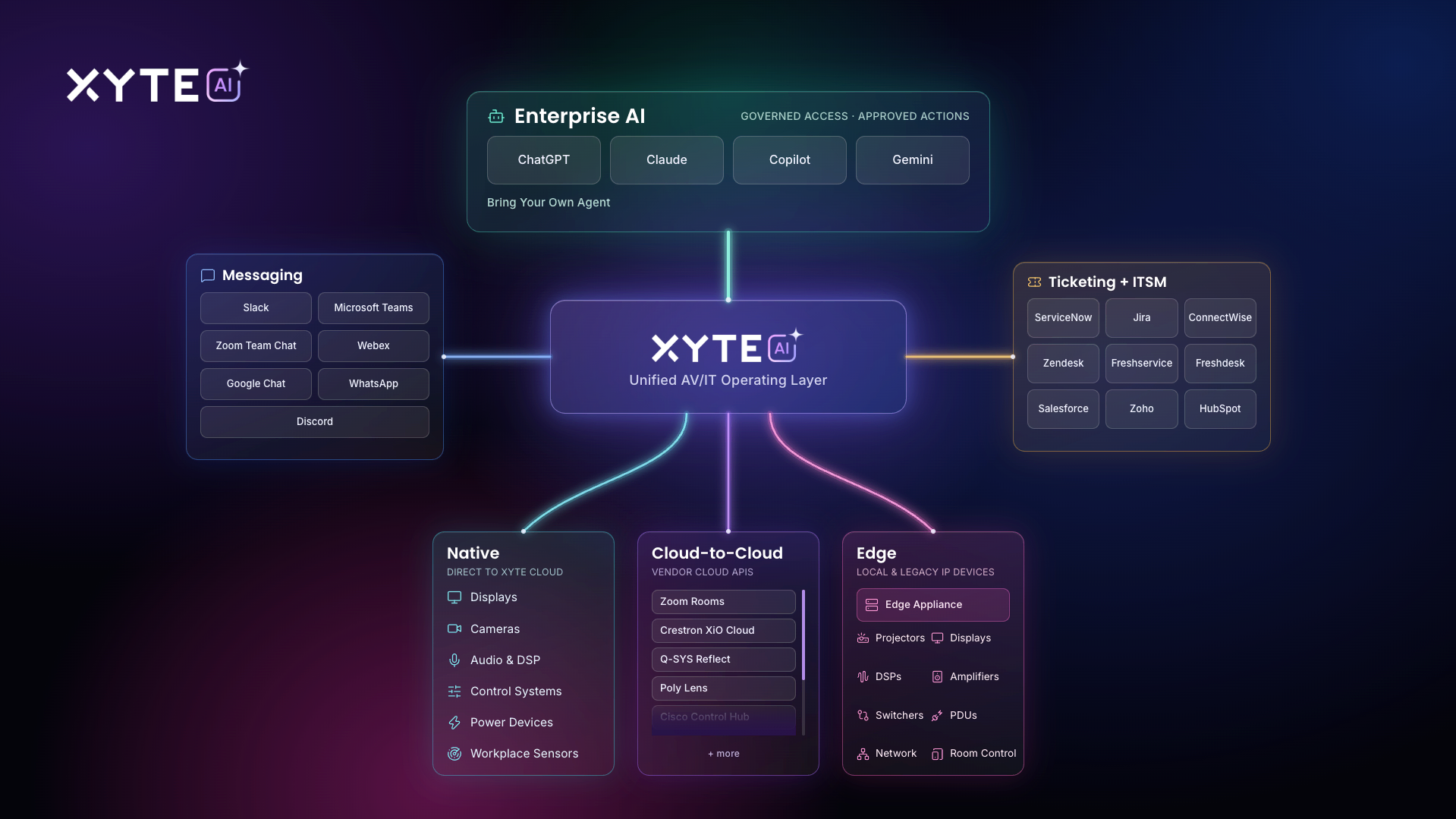
The one thing I didn't predict in my preview post was the interest in Xyte CLI. We launched CLI earlier this year as a command-line tool that gives IT teams and AI agents a shared interface for managing devices across their entire environment. Almost every enterprise customer who walked into our booth asked about it. Vladimir Porton, Xyte's AI Lead, was running live CLI demos at his station - and it was the busiest spot in the booth, all three days.
The appeal of CLI makes sense when you think about how enterprise IT teams actually work. These are people who live in their consoles. They've built custom workflows, automated reports, and integrated tools that all run from the command line. The last thing they want is another dashboard in another browser tab. Xyte CLI lets them pull device status, check room health, and trigger actions from the same console they already use for everything else. Around 70% of the enterprise visitors we spoke with expressed direct interest in CLI integration, and several were ready to start building it into their workflows immediately.
Downtime Drove Most Conversations
Customers, partners, integrators - everyone wanted to know the same thing: when a room goes down, how fast can you bring it back, and can you do it from your desk?
The AV ‘nightmare scenario’ that came up several times was a high-visibility space - a CEO giving a presentation, a board meeting in progress - and a poorly-timed display freeze. Nobody is going to walk up to the screen and troubleshoot it in real time. That's where the ability to reset a device remotely changes the equation.
In this context, our recently-announced NETGEAR switch integration got a lot of mindshare. A lot of the people we spoke with use NETGEAR switches, and Xyte can reset an individual PoE port on those switches remotely. That means if a device goes unresponsive, a team of five people managing thousands of rooms can power cycle it in minutes - even if Xyte doesn't have a dedicated driver for that device. The switch handles the reset at the port level. We're building the same capability for other switches now.
Sony demonstrated a related capability on our platform - zero-touch provisioning, where a display can be configured with a few clicks. The idea is the same: keep the room operational with as little on-site time as possible.
Hardware Is Being Built for the Long Run
One customer I've known for years told me he goes with QSC every time because their products are reliable, flexible, and still performing years after installation. That kind of brand loyalty tracks with what I heard at InfoComm - teams want to install something once and get five to eight years out of it.
Interestingly, manufacturers are engineering that longevity from the chip level. The new generation of all-in-one video bars, for example, is shipping with Qualcomm's top-tier SOC - a platform far more powerful than the product needs today. That's on purpose. The hardware is overbuilt so the manufacturer can keep adding software features, security patches, and new functionality for years without a hardware refresh.
Most hardware manufacturers I saw were filling portfolio gaps - launching an all-in-one bar they didn't have, or a particular device category they were missing. The industry is investing heavily in making what already exists last longer and do more over time.
The Bottom Line
The thread connecting every conversation I had in Las Vegas is operations. The industry isn't chasing new categories of hardware or waiting for the next big platform shift. Teams want their rooms to stay up, their support staffs to stay small, and their investments to last. And they want to manage all of it from the tools they already use - whether that's a CLI console or a cloud dashboard. The vendors who can deliver on that will be the ones getting the meetings this year. The trade show floor at InfoComm is done with promises. Next year, like this year, attendees will want to see results.