The sustainability conversation in enterprise AV tends to focus on hardware. Recent industry trend analysis found that enterprise sustainability frameworks and procurement guidelines tend to focus almost entirely on physical hardware - spec'ing out lower-wattage components, hunting for sleep-mode efficiencies, and adopting technology that extends display lifecycles. Yet, while important, enhanced hardware efficiency represents only one part of the sustainability equation.
A larger area of waste is entirely operational. In buildings across the enterprise AV landscape, rooms sit empty for hours or days at a time while AV racks draw full power on a fixed schedule. No one notices, because the devices are functioning exactly as designed. The displays are on, the processors are running, and every status light is green. The systems have no way to know whether anyone is in the room - and no reason to care.
Data from Xyte's Midyear 2026 AV Cloud Data Report illustrates what becomes visible when you connect these data streams. In this post, we'll look at an energy savings opportunity most AV teams can't see today, and what becomes possible when power, occupancy and other environmental and usage data are joined in the same operational layer.
Case Study: The Building That Emptied Out
In a university deployment tracked in the report, Xyte connected two data streams from the same rooms: CO₂ readings from environmental sensors (used to measure occupancy) and real-time power draw from metered AV rack PDUs. The two streams came from different vendors and were not organically designed to talk to each other.
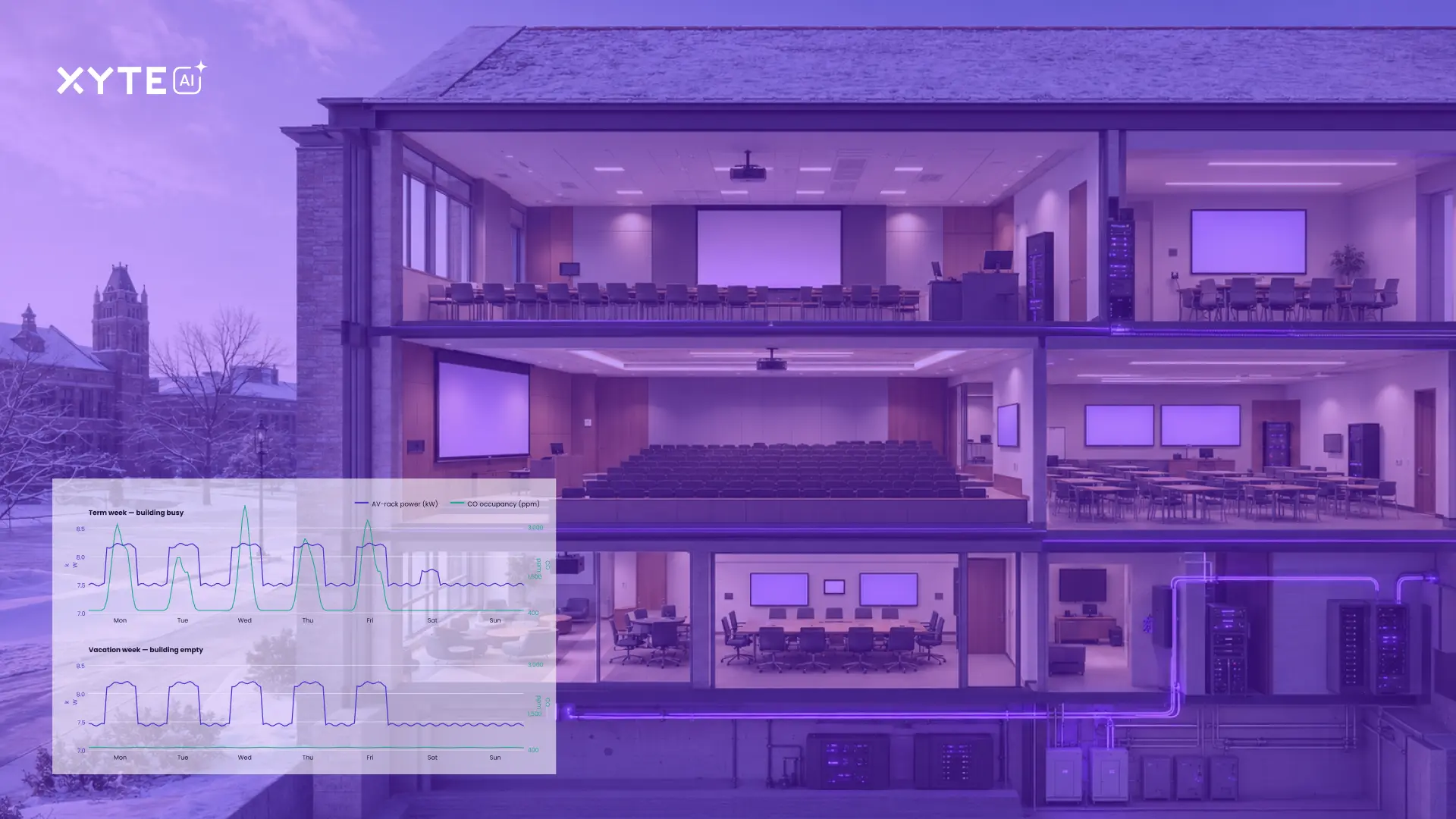
Once the two streams were joined in the same layer, a vacation exposed significant energy waste that neither system could have seen alone. During this holiday break, the building emptied out - no classes, no meetings, no people. CO₂ levels flatlined, occupied hours in the building fell from 47 to zero. Yet AV rack power barely fluctuated. The racks kept running on their usual schedule, drawing nearly identical power to a busy term week. An entire building's worth of AV equipment was consuming full power with no one there to use it.
In the graph below, you can see the two weeks side by side. During the term week, power and occupancy rise and fall together. During vacation, occupancy disappears and power stays flat. Nothing was done because every device reported as healthy - the monitoring systems, each from its context-free perspective, saw nothing wrong. The waste was entirely invisible to any system that only tracks device status.

In this building alone, occupancy-aware control could save roughly 30 MWh per year, reduce AV rack energy by about 44%, avoid some $3,900 in annual electricity costs, and prevent nearly 12 tons of CO₂ emissions. Across the same university's broader AV footprint, those numbers could scale to roughly 245 MWh, $32,000, and 95 tons of CO₂ per year. For any large organization with AV deployments across multiple buildings, campuses, or sites, the cumulative waste caused by non-contextual monitoring can be significant - and entirely preventable once the right data streams are connected.
The Bigger Issue: Why Monitoring Misses It
This problem of wastage is not, of course, confined just to this university. Across enterprise AV, sustainability initiatives tend to stop at the hardware layer. The operational layer, which is responsible for actual energy consumption day after day, remains largely unaddressed.
And this pattern mirrors an even larger management problem. According to the EPA and Department of Energy, 30% of commercial building energy is wasted due to poor management - at a cost of $150 billion annually in the U.S. alone. AV systems are just one contributor to that waste, and one of the least visible.
The problem is that traditional device status monitoring was designed to answer one question - is the device online? When the answer is yes, the system moves on. There is no follow-up question about whether the device needs to be online - whether anyone is in the room, whether the space is booked, whether the building is occupied.
The data to answer those questions exists in the organization - in occupancy sensor systems, room booking systems, environmental monitoring systems, badge access logs and more. But these systems are all separate, managed by separate teams, purchased from separate vendors. This is the standard, not an outlier - across Xyte's Connect+ base, 94% of all managed devices sit in multi-brand environments. The same fragmentation that makes incident response harder also leaves energy waste invisible.
From Seeing to Solving
Energy-efficient AV hardware is, of course, one of the pillars of sustainability. But it is far from the only one. Once occupancy, scheduling, and power and other data are unified in the same operational layer, organizations can eliminate a whole class of waste that status monitoring alone can never detect. For many enterprise AV environments, that may represent the largest sustainability opportunity of all.