
A snake sheds its skin when the layer underneath outgrows the one on top. Salesforce just did something similar. At its TDX developer conference in April, the company introduced Headless 360 - shedding a GUI-centric approach in favor of agentic AI. The company opened up every capability on its platform as an API, MCP tool, or CLI command, so that AI agents can access data, trigger workflows, and deploy applications alongside human users - or instead of them.
The implications of this move cannot be overstated. A $250 billion enterprise software company is telling the market that the GUI, the layer its customers have clicked through for decades, is no longer the center of gravity. Salesforce made this decision because enterprise work is moving beyond screens. Agents, automations, and internal workflows need direct access to the data and actions inside the platform, without waiting for a human to click through a sequence of pages.
I've been watching this closely because we have been building toward a similar access model at Xyte: one where enterprise teams can manage physical device infrastructure through the interfaces their people, systems, and AI agents already use. The industries are different, but the infrastructure question is the same. In this blog, I'll make the case that AV is already on the same trajectory as Salesforce, and that the enterprises paying attention to Salesforce's move should be asking the same question about their AV device infrastructure.
What an Agent-Ready AV Platform Looks Like
Salesforce organized its platform around four systems: context (Data 360), work (Customer 360 apps), agency (Agentforce), and engagement (Slack and other surfaces). Headless 360 exposes all four as APIs, MCP tools, and CLI commands. Any AI agent - whether it runs on OpenAI, Anthropic, or a company's own stack - can access any layer directly.
The platform still has a GUI to serve daily users, display the results of agent workflows, and support visual development tools. For enterprise-scale workflows - automated pipelines, cross-system orchestration, agent-driven processes - the API and CLI become the primary access points. The GUI becomes one interface among several.
That same architectural choice - GUI for daily operations and visual workflows, API and CLI for enterprise-scale automation - is where AV needs to head (and already is).
AV: Same Issues, Different Market
Enterprise AV environments are reaching the same architectural moment Salesforce described with Headless 360. The issue is no longer whether teams need another interface to monitor devices. For many SMBs, schools, and operational teams, a strong UI is still essential. But large enterprises are increasingly moving in a different direction: they want AV device infrastructure to plug into the same agentic AI workflows, automation systems, and internal tools they already use across the rest of the business.
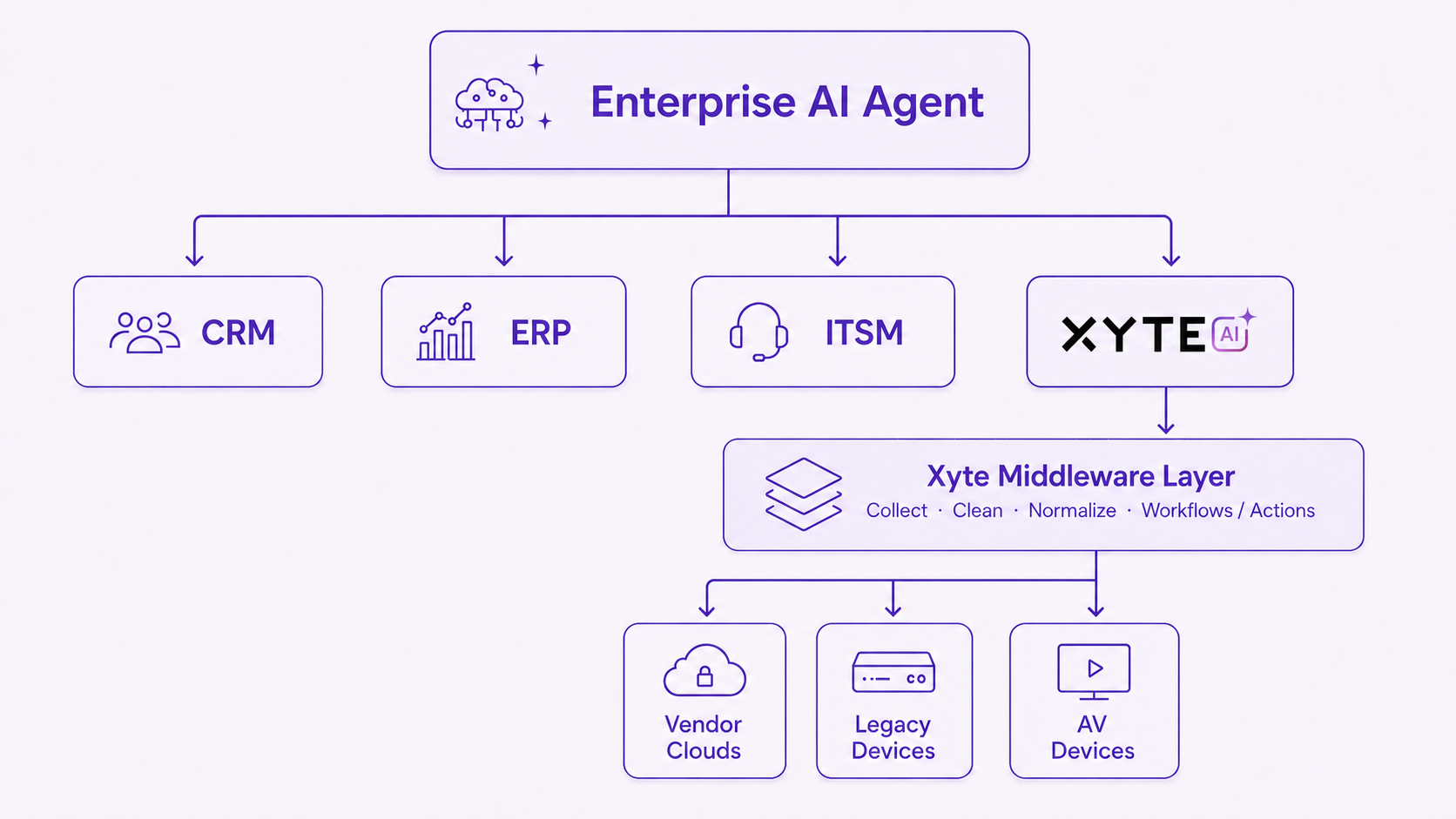
That changes the role of the AV management platform. It can’t just be another dashboard. It needs to become the middleware layer that collects data from every device and source, including legacy systems, cleans and normalizes that data, and exposes it through APIs, CLI, MCP, and other machine-readable interfaces. In that model, enterprises do not need to onboard another tool for every workflow. Their agents and internal systems can interact with AV infrastructure directly, through a governed access layer built for scale.
Pre-headless Salesforce looked the same way. The platform could do almost everything an enterprise needed, but too much of that capability still assumed a human working through an interface. For enterprise AV to become agent-ready, it needs what Salesforce built for CRM: a shared access layer that lets agents, automation, and enterprise systems reach the underlying data and actions directly, without forcing every workflow through a screen.
Rado Soroka, Principal Collaboration Engineer at Snowflake, framed this shift well at our recent AV Cloud Summit: "We need to bridge the gap between siloed data and have our agents actually interacting with data pipelines for Zoom, for Teams, for LogiSync - querying all of that information and finding the resolution." In the same session, he discussed his use of Xyte’s CLI tool, through which he was able to claim hundreds of displays in minutes. “I do love the Xyte UI, but I haven’t seen it for a while because I’m doing things through CLI.” Headless 360 gave CRM that machine-readable access layer. Enterprise AV needs the same.
What a Headless AV Platform Looks Like
Most enterprises don't build their own CRM. They customize, configure, integrate, and build on top of a platform like Salesforce. AV device management should work the same way. For an enterprise like Snowflake, it already does - Xyte serves as data aggregation middleware, a single layer that normalizes device data from every vendor and makes it accessible to agents, automation, and custom applications.
Xyte's architecture mirrors what Salesforce built with Headless 360. Enterprise teams and their agents interact with the platform through APIs, CLI, and Xyte's MCP server. The GUI serves the people who manage devices and review the results of agent-driven workflows. Enterprise teams can build on top of the access layer the same way they build on top of Salesforce - their own reports, their own agent integrations, their own operational workflows.
What This Looks Like in Practice
When every capability is exposed through APIs, a CLI, and an MCP server, work that used to require a human in a portal starts to run on its own. Just a few examples of how this might work:
Cross-vendor monitoring: Instead of logging into four vendor clouds each morning, an agent queries Xyte once for the health and history of every device across every site (Zoom Rooms, Teams Rooms, Crestron, Q-SYS), flags the displays that went dark and the codecs reporting degraded status, and opens a ticket for each before the first employee walks in.
Configuration drift, checked and fixed at scale: A systems integrator runs the CLI across more than 1,000 Crestron NVX endpoints to pull each one's configuration in a single pass, compares it against the intended baseline, surfaces the roughly 100 that had drifted, and pushes the corrected config to just those devices, without anyone opening a screen for each one. Days of manual auditing become a routine an agent can run on demand.
Guided incident response: When a device throws an incident, an agent pulls its full state, identifies the likely cause, recommends the right recovery command, and prepares the action for approval. Once approved, the command runs through the same governed access layer and the fix is verified automatically.
Provisioning a new site: Installing a new office becomes a single repeatable routine. The space hierarchy is created on demand and hundreds of devices are claimed and placed in minutes rather than over days, collapsing a multi-week rollout into a script.
The Bottom Line
Salesforce rethought its entire platform architecture to accommodate agentic AI. AV is at a similar inflection point. The devices, the data, and the operational workflows remain the same. What's changing is how enterprises access them.
None of this is hypothetical demand. At InfoComm, nearly every enterprise customer our team spoke with was asking for the same thing: a CLI and machine-readable access layer they could connect to their own agents and internal workflows, instead of sending teams into another dashboard.
That is the real shift. The winning AV platforms will not just offer a better UI. They will become the middleware layer that makes physical device infrastructure visible, understandable, and actionable to the systems enterprises already use.



![Is My AV Gear Supported? [Hint: It’s Not a Yes-or-No Question]](https://cdn.prod.website-files.com/64b4f17a16222f7b816bb7a9/6ac76147cf570765858d8ad5_blog%20-%20are%20my%20devices%20supported.webp)