
At some point, every AV integrator who makes the shift to managed services hits the same wall. The client roster grows, the device and room count climbs, and SLA commitments stack up. The team that used to handle everything so well starts to show the strain. Trucks roll more often than they should, even as the margin on service calls grows thinner.
The good news: this is a structural problem, and it's entirely solvable.
In this blog, we’ll walk through the operational building blocks that help integrators scale AV managed services without burning out their teams, including remote monitoring, AV service operations tooling, and a service structure built to grow.
Why Managed Services Teams Burn Out
If your team is managing more devices across more client sites with no centralized visibility into what's online, what's failing, or what's about to fail, you're not alone. It's one of the most common pressure points in a growing managed services practice.
It looks like this: every issue starts with a service call from the client, response times slip, SLA commitments get harder to meet... Ultimately, the team that was once on top of everything starts to feel permanently behind. This is the operational profile of a managed services business heading toward burnout, and it arrives faster than most AV integrators expect.
When this type of pressure builds, one instinct is to hire. Add a technician or a coordinator, and you add capacity - this is the theory. Yet more headcount can only address the symptoms. The underlying problem is an operation that waits for client calls rather than getting ahead of them. The integrators who scale AV managed services successfully invest in their operational infrastructure before volume demands it. And they stop waiting for clients to tell them something is wrong.
From Monitoring to Action
For AV integrators, remote monitoring is the foundation for scaling managed services. The best remote monitoring AV integrator workflows do more than surface alerts. They route issues quickly, enable remote resolution, and reduce unnecessary truck rolls. When your team sees problems before the client calls, the entire service model shifts. Integrators that make this transition report on-site visits dropping by up to 85%, with MTTR nearly cut in half.
Once monitoring is in place, the bigger question is what you do with it. Knowing a device is offline is helpful. Knowing why, and fixing it at scale, is what moves the needle. That’s where AI adds value by spotting anomalies, predicting failures, and recommending action before the client feels the impact.
The right tooling routes alerts automatically, supports remote diagnosis, and resolves common failures like display issues, audio dropouts, and codec connectivity without a truck roll. It surfaces patterns early through predictive analytics and keeps firmware current on schedule. That’s how a lean team stays ahead of a fleet that might otherwise need twice the headcount.
The service delivery side matters just as much as the technical side. Quarterly system health reviews, always-on customer portal access, and regular SLA compliance reporting give clients a clear picture of uptime, utilization, and what they're getting for their investment. For your team, it creates a repeatable delivery structure that holds up as the client roster grows.
Structure Tiers and Pricing Before You Scale
One of the most common mistakes integrators make when shifting to managed services is building their service structure reactively. When you price and package services on the fly, deal by deal, it gets harder to deliver a consistent offering. The time to define your tiers is before volume grows.
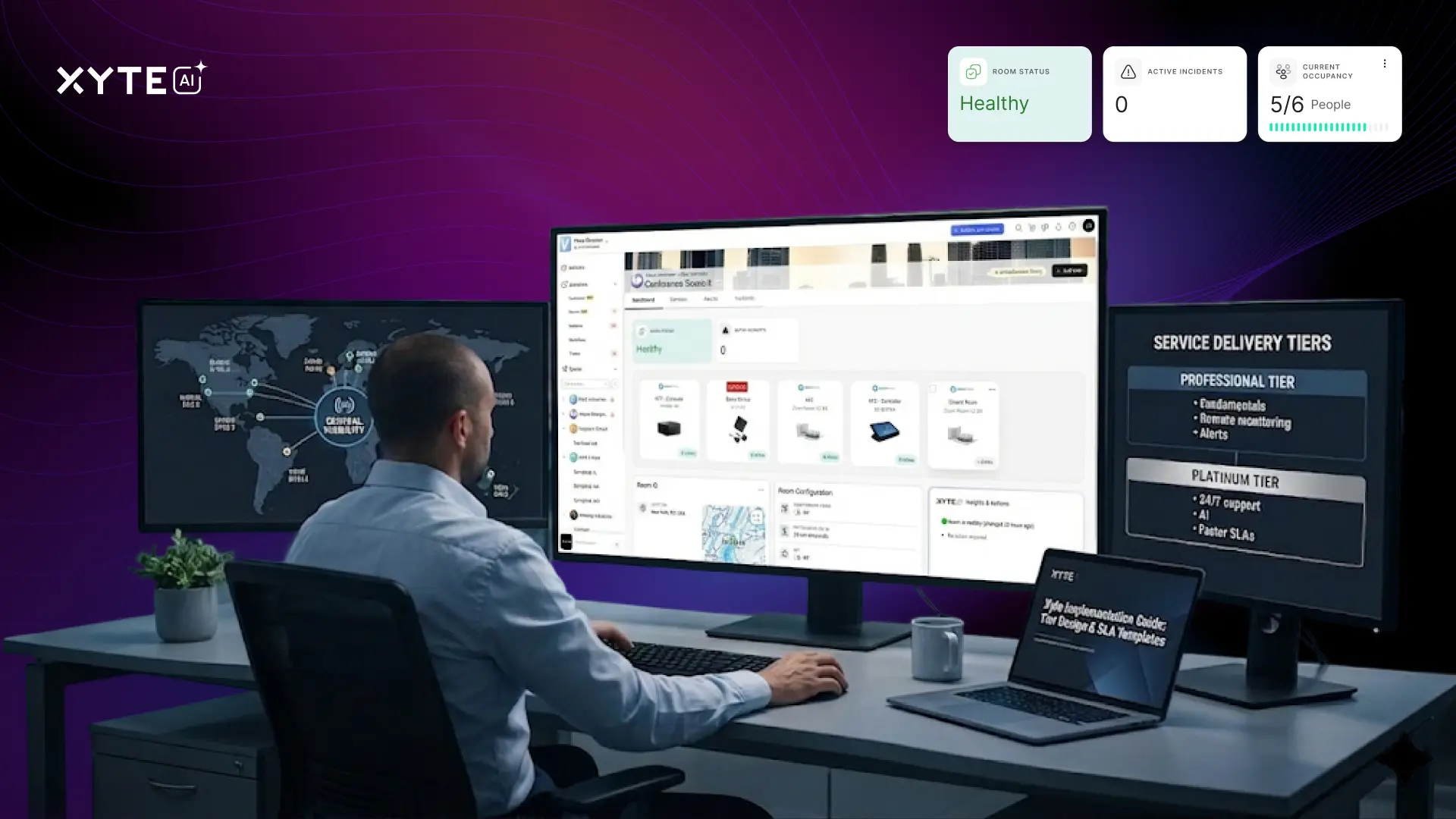
A two-tier model works well for most integrators. For example, a Professional tier that covers the fundamentals: remote monitoring, automated alerts, business-hours support, and quarterly performance reports. A Platinum tier layers on 24/7 support, AI-powered predictive analytics, faster response commitments, unlimited onsite service, and monthly executive reporting. The gap between the two tiers gives clients a meaningful choice based on their uptime requirements and budget.
Pricing structure deserves the same intentional approach. Consider presenting your full service offering as a single line item on the proposal: on-site service, warranties, monitoring, preventative maintenance, and reporting bundled under one fee. Monitoring and management sits inside that package, absorbed into the overall service value. This protects your margin and keeps the conversation focused on what you're delivering rather than the mechanics of how it's delivered.
Where to Go from Here
Most managed services practices hit the same inflection point eventually. The client roster is growing, the SLA commitments are stacking up - and the team that built it all starts to show the strain. The work that felt manageable at 20 clients starts to feel overwhelming at 50. That's the burnout curve, and it's what happens when a growing service business runs on a services infrastructure designed for a smaller one.
To avoid burnout, system integrators need to invest in their operational infrastructure early. They need to build the monitoring foundation and service structure before volume demands it and gain visibility across every site. They need workflows that route issues without manual intervention, AI that surfaces problems before clients feel them, service tiers that set clear expectations on both sides, and a pricing structure that protects their margin. That’s how integrators build service operations that scale without breaking their teams or their margins.
Ready to scale AV managed services practice with more consistency and less strain? Xyte created a practical guide for AV integrators covering implementation frameworks, service tier design, pricing structure, and SLA templates. Download it today!



![Is My AV Gear Supported? [Hint: It’s Not a Yes-or-No Question]](https://cdn.prod.website-files.com/64b4f17a16222f7b816bb7a9/6ac76147cf570765858d8ad5_blog%20-%20are%20my%20devices%20supported.webp)