
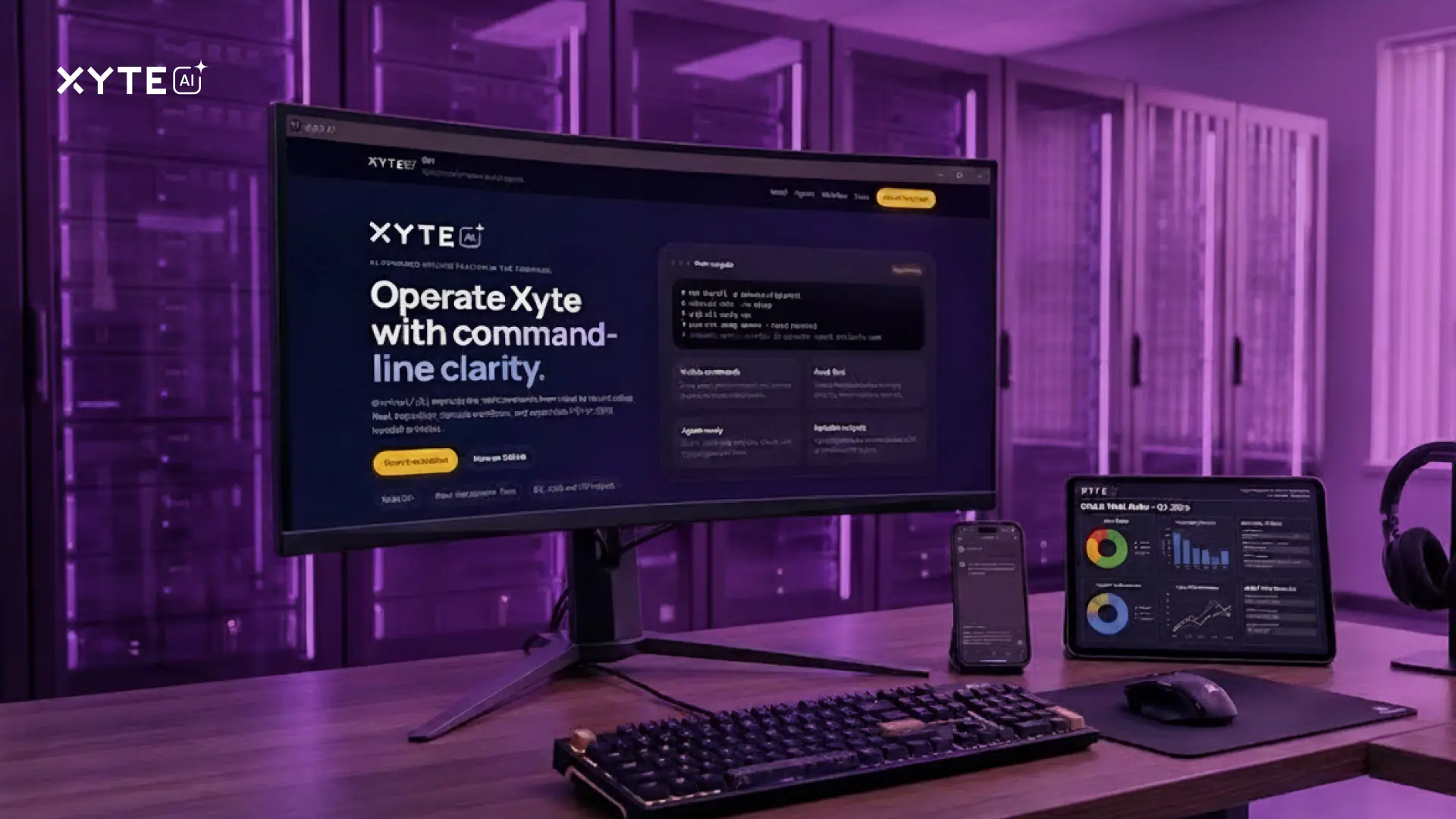
AI agents are no longer something enterprises are just evaluating. They are already hard at work, every day. Gartner projects 40% of enterprise applications will embed task-specific AI agents by the end of 2026 (it was less than 5% in 2025). Clearly, agents have moved from experiment to infrastructure – and that shift actually happened faster than many AV and IT operations teams anticipated.
This has created challenges. Notably, the platforms managing most device estates were built for humans navigating dashboards - not for agents parsing commands. This means that teams are not yet reaping the full benefits of agentic AI because their AV and device management platforms have no way to connect to the agents they are already using.
In this post, I'll walk through how Xyte CLI - a command-line interface built specifically for AI-driven device operations - closes that gap, and why getting connected is simpler than you’d expect.
The Missing Link Between AI Agents and Physical Infrastructure
AI agents need three things to thrive: clear, unambiguous commands, structured machine-readable outputs, and a safe way to execute actions. The issue is that most AV platforms provide none of these. And with good reason. After all, they were built for human operators navigating a portal - not for agents that need to parse instructions, retrieve structured data, and act on physical devices with precision. When an agent hits a GUI-first system, it either guesses or gives up.
This is what Xyte calls the translation risk - unstructured AI interacting directly with physical infrastructure, without a purpose-built execution layer between them. The results are predictable: misread commands, actions with no audit trail, and outcomes nobody can verify. And because traditional interfaces force agents to behave like humans, everything slows down.
Like most platforms, Xyte was built for human operators – with data, control, and device management capability locked inside the portal. Now, Xyte CLI opens that up to the agents that your team is already running every day.
What Xyte CLI Actually Does
Xyte CLI is the execution layer that connects your AI agents directly to your infrastructure - enabling the kind of automation and control that a dashboard was never designed to deliver.
What does that look like in practice? For example, one of our salespeople connected his own ChatGPT to his Xyte environment in just minutes. He pulled up the Xyte CLI landing page, told the agent to install the skills directly from there, then passed it his Xyte API key. Once it confirmed the connection, he typed a plain-language request: run me a fleet report. Seconds later, he had a clean, shareable PDF covering his entire device estate - generated entirely through a conversation in the same AI terminal he uses for everything else.
That is what Xyte CLI makes possible for any enterprise team already running AI agents. Fleet inspection, incident investigation, remediation workflows, custom reporting - all of it is now accessible through a plain-language conversation with ChatGPT, Claude, Copilot, or your AI tool of choice.
How Does Xyte CLI Work?
A raw AI model has no idea how to interact with your device estate. Without guidance, it would search the web for documentation, try out commands, and piece together what the CLI does through trial and error. Xyte CLI eliminates that with a single install command that deploys a set of pre-built, structured instructions that teach your agent exactly how to use Xyte CLI.
Once those instructions are in place, the agent knows exactly what to do - it reads what it needs, builds valid commands, handles authentication and context automatically and stops to ask for human approval before executing anything that changes device state.
From there, the range of what your agents can do expands quickly. Teams are already using Xyte CLI to schedule consistent health snapshots across thousands of endpoints and automatically flag unusual behavior. Incident investigation that used to mean pulling data manually now involves asking an agent to generate a full root cause analysis report. Controlled remediation - reboots, configuration fixes, patches applied across large fleets - runs with auditable, repeatable workflows, and every step is documented and applied consistently across every affected device.
For managed service providers, the benefits are dramatic. MSPs typically juggle multiple platforms across multiple clients. With Xyte CLI, they can pull device data together from across systems, build joint automations, and generate consolidated reporting - all through the AI tool their teams already use.
The Bottom Line
Enterprises are moving fast on agentic AI. The ones gaining the most ground are those that are giving their agents the tools they need: live data, actionable commands, and a clear path to execution. Until now, AV and IT operations lagged behind that curve because the tooling did not exist to bridge the two worlds.
It does now. And it does not require a dedicated engineering team or a months-long integration project. Without a direct execution layer, AI agents cannot turn insight into action across your AV infrastructure. Xyte CLI is that layer.
Ready to give your AI agents live data, actionable commands, and a safe path to execution? Xyte CLI makes that possible.



![Is My AV Gear Supported? [Hint: It’s Not a Yes-or-No Question]](https://cdn.prod.website-files.com/64b4f17a16222f7b816bb7a9/6ac76147cf570765858d8ad5_blog%20-%20are%20my%20devices%20supported.webp)