.webp)
In the early 2020s, self-healing sounded like the future. The idea was almost science fiction: a system detects a known problem, runs a pre-set fix, and moves on – no human required. AV teams adopted it en masse because, at the time, it was the best answer the industry had.
AV tools have improved. And with better tools, the limits of self-healing are easier to see.
It can’t explain what changed.
It can’t explain why a failure occurred.
It can’t confirm whether the fix actually worked.
In large-scale AV environments, that’s a problem.
In this blog, we'll break down why self-healing falls short in the AV space, what guided remediation actually looks like in practice, and why the distinction matters for teams managing AV at scale.
What Self-Healing Actually Does
Self-healing runs scripts. When a known condition is detected, it fires a pre-set response. That loop works as long as the problem matches the script. When it doesn't, one of two things happens: nothing, or the wrong action runs without anyone knowing.
The concept took root in AV earlier than most remember. A 2019 AVNetwork article offered a typical example of self-healing in practice: assess the probability a projector alert can be resolved with a reboot, check whether a meeting is coming up, and if there is a meeting in 10 minutes, but the system knows that this device has a three-minute reboot process, the system automatically reboots without any human interaction.
A probability check followed by a script – that's what self-healing is. There’s no context, no explanation, no understanding of the root cause. And this deficiency carries a price tag. For example, research suggests that up to 40% of truck rolls can be resolved remotely – but remote resolution only works when teams understand the issue.
A script doesn't know whether standby mode was triggered by a settings change, a network drop, or a firmware conflict. When it guesses wrong, the engineer dispatched to the room now has two problems to diagnose: the original failure and whatever the script changed trying to fix it.
Self-healing was the best the industry could do with the tools available at the time. The toolset has changed - and with it, the standard for what good operations actually look like.
Why AV Environments Make Self-Healing Especially Brittle
Part of the reason self-healing struggled to keep up is the environment it operates in. AV environments have grown far more complex than when self-healing was conceived. They're built from rooms, devices and networks that span multiple sites, geographies, and customer environments, with hundreds of endpoints drawing from dozens of manufacturers, each interacting with the others in ways that shift constantly. And nearly 49% of those manufacturers have their own firmware behavior, signal handling, and failure modes.
Scripts can't model that level of complexity. They're written for known conditions in controlled environments. A reboot script written for one projector model may behave differently on another. A firmware update that stabilizes one device can destabilize a device connected to the original device. And unlike software environments where variables are largely known, AV rooms introduce conditions no pre-written playbook anticipates - room temperature, cable degradation, network congestion, user behavior.
There's also the problem of cause. AV failures rarely announce themselves cleanly. A display going dark could point to a power issue, a source problem, a control system fault, or a network drop. A self-healing system fires the same response regardless - because it has no way to tell the difference. It sees a trigger condition and executes. What it can't do is understand what the environment was doing before the failure, what changed, or what the right response actually is for this device, in this room, at this moment.
The Agent-Guided Remediation Model
The model that actually works for AV is automation with human judgment built in. The goal is to give people the right information at the right moment so the decisions they make are informed ones.
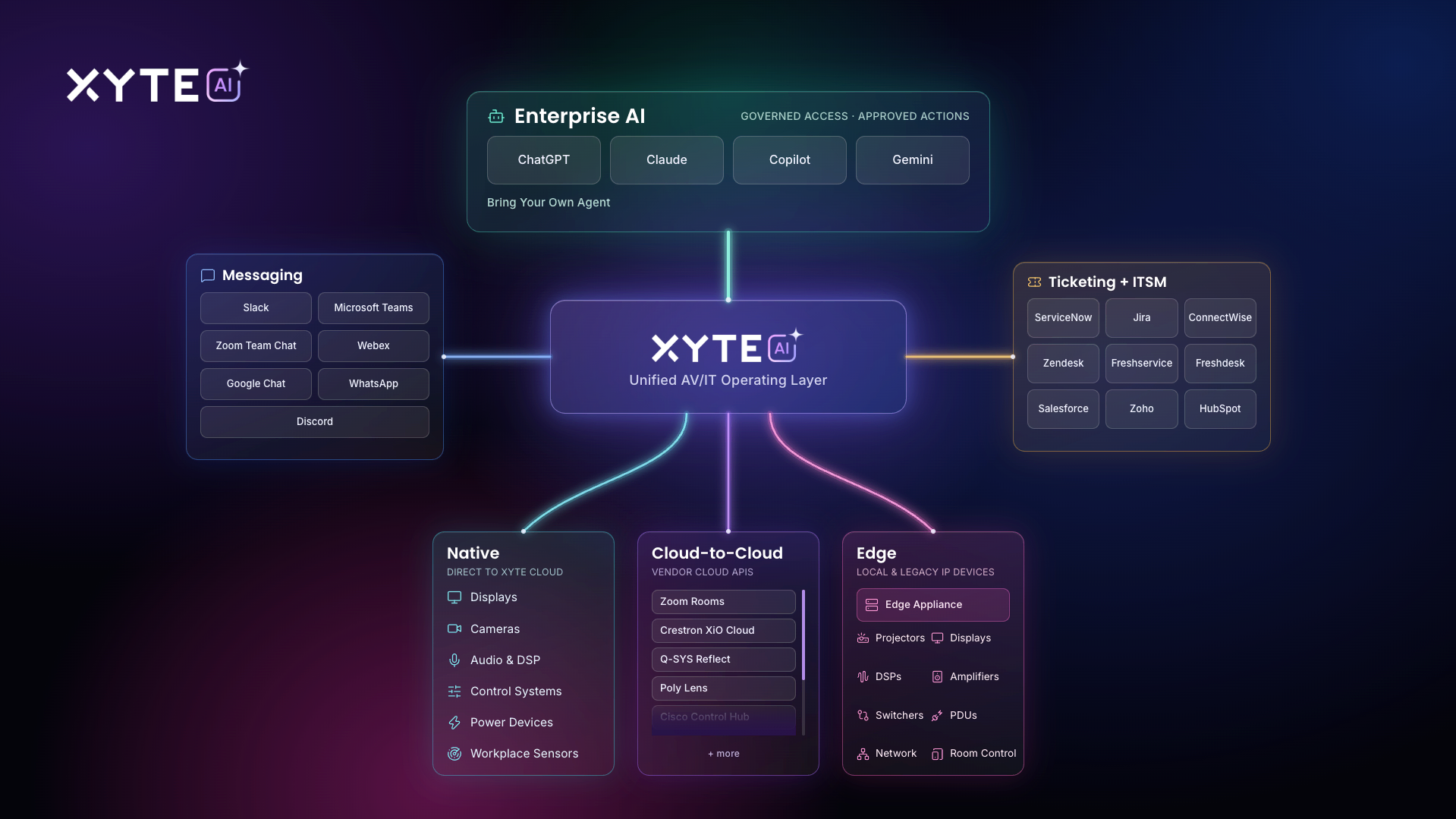
We call this model agent-guided remediation. Where self-healing fires a script, agent-guided remediation builds understanding first. AI embedded across devices, rooms, and workflows detects an issue in real time, draws on environmental context, incident history, and usage patterns to analyze what changed and why, and recommends the action that fits the specific situation. A human - or an authorized AI agent - then executes. The system handles the diagnosis. The operator retains control of the outcome.
A firmware update is a good illustration. When a new version becomes available for a device, a self-healing system might push it automatically. An agent-guided remediation model surfaces the update, flags that newer doesn't always mean better, and puts the decision in the operator's hands. The system contributes intelligence. The operator makes the call. That sequence – awareness, recommendation, decision – is what keeps AV environments stable at scale.
The Bottom Line
Self-healing solved a real problem. But it only handles known issues.
Modern AV environments are dynamic. They require systems that can interpret signals, explain what changed, and guide the right response in real time.
That’s the shift.
From scripted fixes to informed decisions
Teams that adopt agent-guided remediation are better equipped to scale without adding operational risk.
See what it looks like when AI handles the diagnosis and your team makes the calls - across every device, room, and customer in a single operational view. Book a demo today.