
The enterprise AV industry has spent the last several years investing in smarter devices, better dashboards, and more connected rooms. That investment has paid off in productivity and connectivity, of course. Yet it has also produced enormous amounts of data - telemetry, alerts, tickets, usage patterns, firmware logs, room health signals, you name it. When combined with AI, this data represents one of the biggest opportunities in the future of enterprise AV: the ability to move from reactive management to predictive, context-aware intelligence. But before the industry can realize that future, we have to solve a foundational challenge: how to collect this data across systems, and how to preserve the operational context that siloed platforms simply do not, and cannot, provide. Today, that data remains spread across vendors, platforms, and teams.
To make sense of all of this, many in our industry are turning to AI-powered tools and agentic AI - systems that can help you take action across workflows, not just generate insights.
This will be a key issue in the upcoming AV Cloud Summit (Spring 2026): what it takes to move from isolated automation to agentic AI that can operate across complex, multi-vendor environments, as well as the potential new opportunities this shift creates for enterprise IT teams/executives. That starts with a strong data foundation - the layer that aggregates, normalizes, and gives AI the essential context it must have to deliver something of real value. In this blog, I'll share why the industry's data problem is the real barrier to AI progress, what it takes to turn fragmented signals into operational context, and what that foundation makes possible.
There's a data problem underneath the AI conversation
As I mentioned above, the AV ecosystem has no shortage of data. The challenge is that none of it connects. The reason? Every manufacturer structures its data differently. Every management platform defines and reports health, usage, and alerts in its own way, and every device category (room systems, control processors, displays, DSPs, cameras, sensors, collaboration endpoints, and more) produces its own stream of telemetry, status updates, logs, commands, settings, tickets, and usage history.
For most organizations, all of that data lives in silos - by brand/vendor or use case. Each team has its silo: one team watches UC device alerts, the second tracks room performance, a third handles firmware versions, failure rates, power consumption, etc. To get the full picture, somebody has to export spreadsheets and manually stitch together dashboards that were never designed to talk to each other.
That is a data problem, pure and simple. And it is also the reason AI has struggled to gain real traction in AV operations - because AI depends on the very context those silos prevent.
AI is only as good as the context behind it
Anyone who’s used ChatGPT, Claude, or Gemini knows the pattern. Weak input, generic output. Strong context, useful answers. AV is no different. Without connected data, AI can only react to isolated signals. With context, it can actually reason across systems.
AI has become the default answer to almost every operational challenge in AV. Yet as I discussed in a previous blog on building the infrastructure for Physical AI, AI agents depend on context to function effectively. The quality of agent output is tied directly to the quality of the context they receive. With the narrow and siloed view we discussed above, AI is flying blind. If the model can only see one device, one room, one vendor, or one event at a time - it can only deliver an incomplete diagnosis, at best.
The siloed view does have some value. AI can pattern-match on a single data stream or flag an alert from a single source, and that's useful to a point. But it’s a long way from the kind of intelligence that enterprise teams actually need - the ability to correlate signals across an entire fleet, understand what changed, identify what's affected, and recommend the right next step. That kind of reasoning requires context, and context requires a connected data foundation.
From raw data to operational context
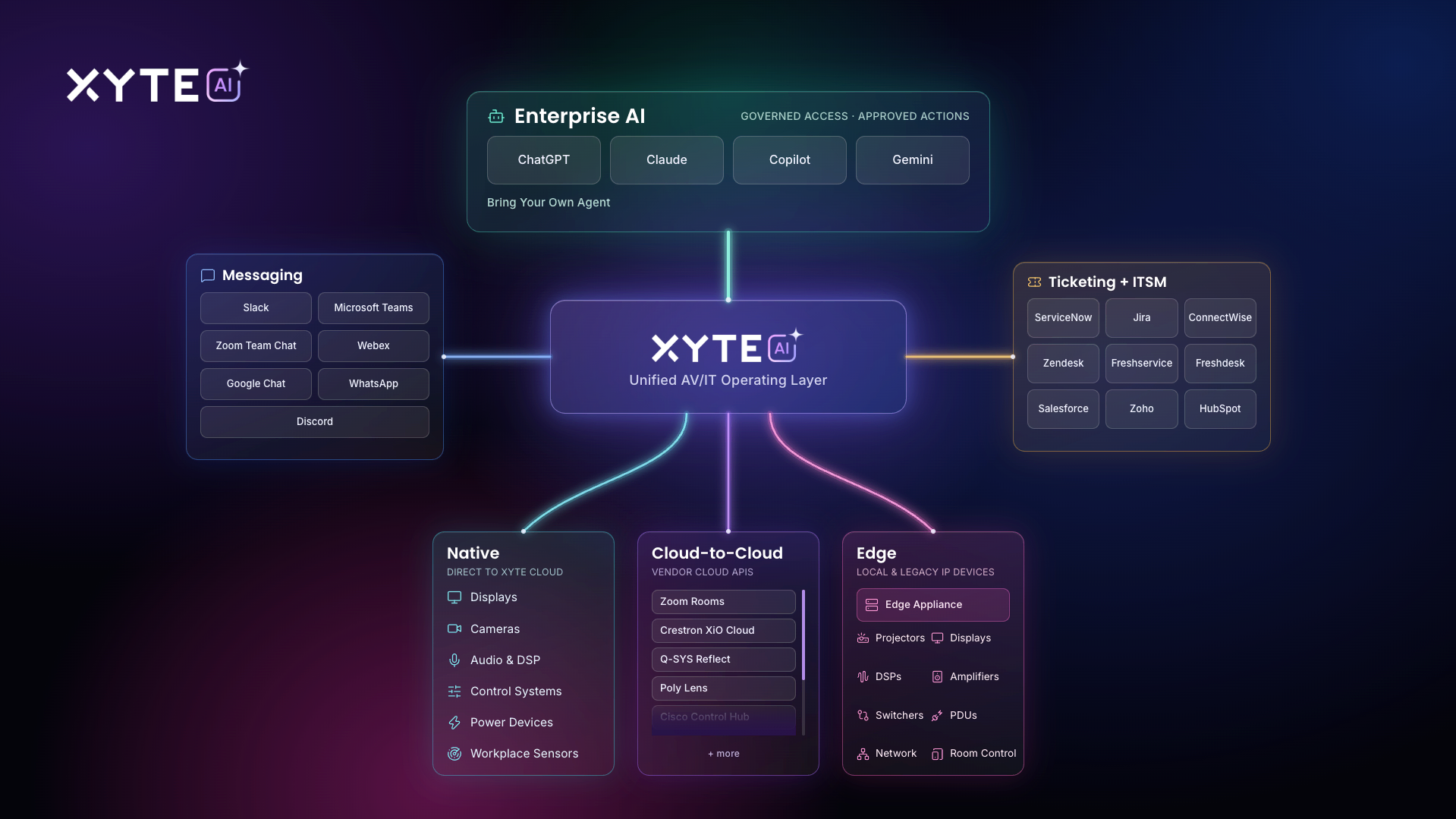
When data from across manufacturers, device categories, room systems, user actions, tickets, and workflows feeds into one normalized, continuously updated layer, you stop seeing disconnected alerts and start seeing connected sequences.
For example, consider a conference room that fails its morning health check. A siloed view tells you the room is down. A connected data layer tells you the camera is online, the DSP firmware is two versions behind, and a configuration change last week triggered the mismatch. It tells you there's already an open ticket from facilities, that the same firmware-configuration pattern is degrading three similar rooms across two other sites, and that the fastest path to resolution is a firmware update - not a truck roll and not a full diagnostic. One team can act on that immediately, across all affected rooms, from a single pane of context.
That is what changes when fragmented signals become operational context. Teams move from "something is wrong in Room 4B" to a full diagnostic picture with a clear next step - and they get there in minutes, across the entire fleet.
Connected data depends on open foundations
That kind of connected data layer only works if the systems feeding it can actually talk to each other. Today, too many AV platforms operate behind proprietary walls that keep data locked in and limit what teams - and AI - can see across their environments. Getting past that takes industry-wide alignment, and that's exactly why we launched OpenAV.Cloud in 2025 alongside founding members including Sony, Panasonic, Legrand, BrightSign, and Shure. The goal is to establish open, secure cloud APIs and shared standards for data access, system telemetry, and cross-platform integration - so the connected data foundation this industry needs can actually scale across vendors, not just within them.
The future of AV is connected data
The AV industry has spent years building smarter devices and more capable platforms. That investment created massive repositories of data that flows from every corner of the AV ecosystem. What we’ve been missing is the connective layer that turns data into action.
That layer is taking shape now, and it is what makes dashboards, guided remediation, cross-vendor workflows, and agentic AI possible at enterprise scale. It is also what makes AI governable - because oversight, guardrails, and accountability all assume the data underneath is structured, reliable, and complete.
The upcoming AV Cloud Summit will put these ideas in front of the enterprise leaders and practitioners who are building this next phase in their own environments. I expect the conversations there to make a strong case for why connected data is the most important investment the AV industry can make right now.