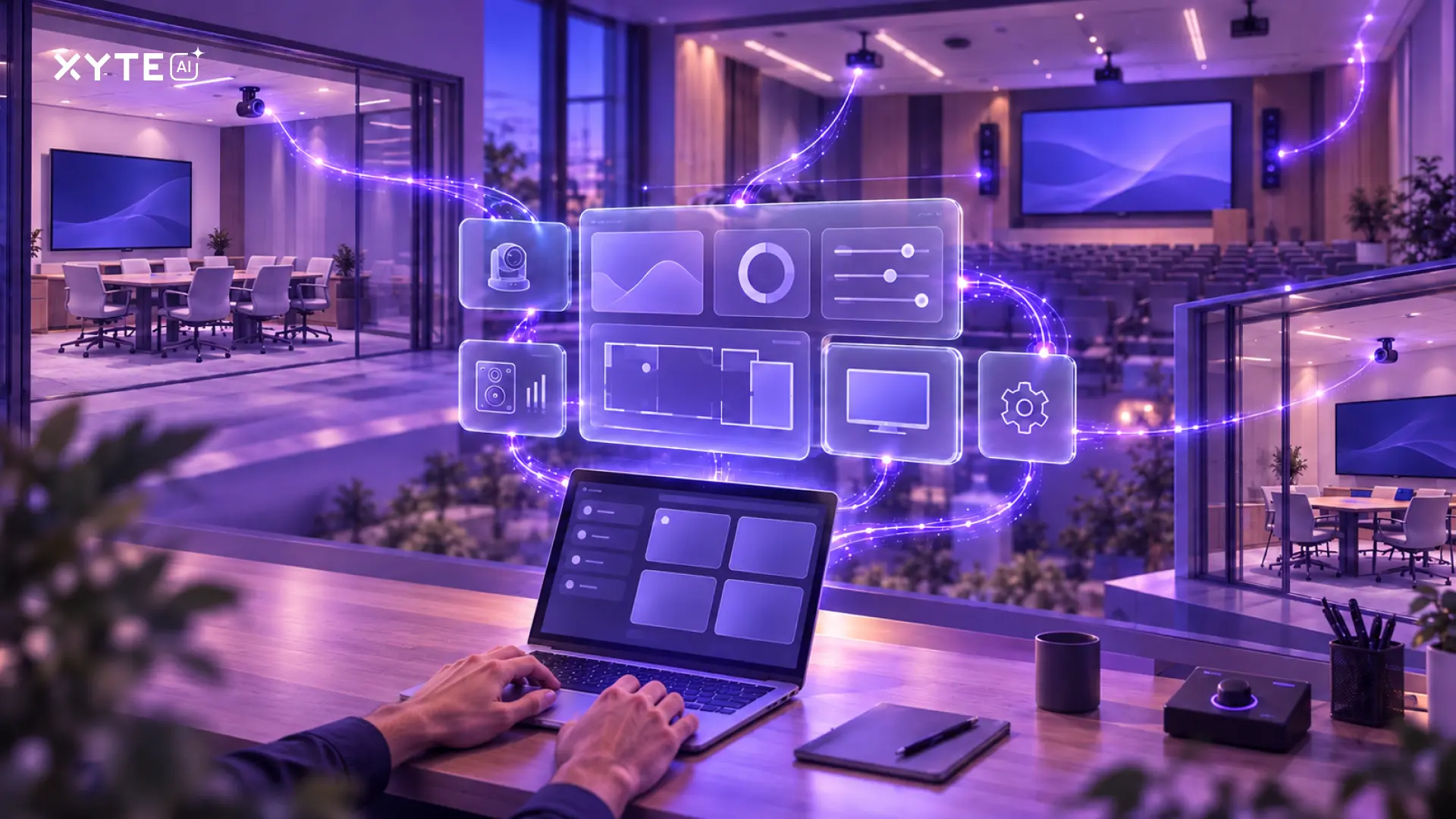
For years, “AI” in AV mostly referred to smart, built-in features - noise cancellation, camera tracking, analytics, and various presets. Agentic AI has changed that, dramatically. Emerging AV AI agents can interpret what is happening across an AV environment, determine what should happen next, and take approved actions across devices and systems.
It’s no wonder adoption is on the rise. A recent AVIXA survey found that 40% of AV end-user organizations already use agentic AI. And IDC predicts that by 2027, half of enterprises will be using AI agents. But what can these agents actually do for AV teams, on the ground? In this blog, we’ll examine four ways agentic AI is being deployed or beginning to emerge in AV - from room configuration and troubleshooting to live production and natural-language device control.
1. The Room That Configures Itself
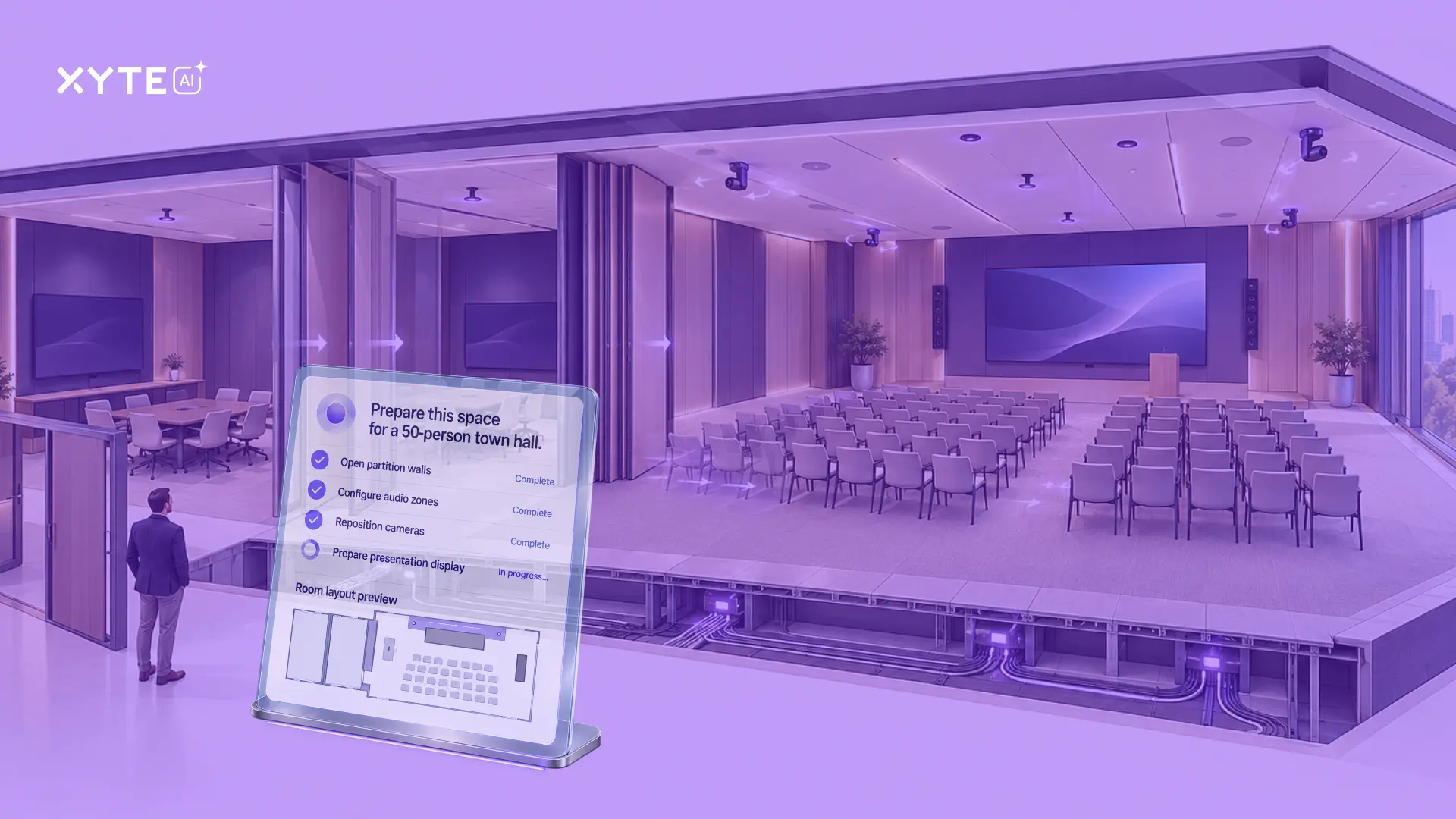
A divisible conference room (one large space that can be split into two or more smaller rooms) is a great example of how agentic AI can change the way day-to-day AV control works.
Traditionally, an integrator had to plan for every room setup ahead of time and program the system to handle each one. If the room was divided or the audience size changed, the system simply switched to the preset that matched that configuration. That worked well for scenarios that were anticipated…but not so well when the room needed to handle something new.
With agentic AI, the user can simply say, “Set up the room for a 50-person town hall.” The agent looks at the current room setup, works out what needs to change, and coordinates the required actions across the AV system.
This is already becoming possible through platforms like Xyte, which gives AI agents access to normalized device data, operational history, and governed actions across multi-vendor AV environments. Depending on the permissions in place, an agent can move from identifying a likely cause to recommending or executing the appropriate response.
That gives AV teams much greater room flexibility. AV teams do not have to program a separate preset for every anticipated request. Instead, the agent can assemble approved device capabilities and workflows to accommodate changing requirements, while remaining within predefined permissions and operational guardrails.
For that to work, the agent needs controlled access to the devices and systems in the room. Companies like American Sound are already developing frameworks that provide that access through APIs.
2. The AV System That Helps Diagnose and Resolve Its Own Problems
A 2026 survey of IT decision-makers found that nearly half rank technology not working properly as the biggest barrier to productive meetings. That makes faster troubleshooting a great place for agentic AI to earn its keep.
If a microphone array starts dropping packets, for example, an agent can check the device and the systems around it, look at recent changes and telemetry, run diagnostics, and work out the likely cause. From there, it can take the next step based on the permissions it was granted. That might mean restarting a PoE port, rolling back firmware, or sending the recommended fix to a technician for approval.
What’s more, because agents can look across the wider AV environment, they have more context to work with. Firmware history, network conditions, configuration changes, and dependencies between devices can all help explain what is happening. For AV teams, that can mean faster diagnosis, faster recovery, and less technician time spent chasing down routine problems.
3. The Production System That Understands What’s Happening
In live video production, someone traditionally decides which camera feed to use, how each shot should be framed, and when to switch to another view. AI-driven production systems can now automate many of these decisions by interpreting audio and visual signals in real time.
Crestron 1 Beyond Automate VX, for example, uses microphone data to locate the active speaker, selects the appropriate camera, and uses Visual AI to frame participants. It can also distinguish sustained speech from momentary sounds, helping avoid unnecessary camera changes. Q-SYS VisionSuite combines audio location data with computer vision to automate camera switching, track presenters, and trigger predefined room actions.
These systems are better described as intelligent automation than as fully agentic AI. They perceive what is happening and respond dynamically, but generally within a defined set of production functions. An agentic layer could take this further by coordinating cameras, audio, lighting, recording, streaming, and system health around a broader goal, while escalating exceptions to a human operator.
4. Natural Language Becomes the Control Interface
Most AV control still relies on buttons, touch panels, presets, and menus. Agentic AI gives users a simpler option: tell the room what you want it to do.
A user might say, “Turn off the side displays, dim the back row lights, and route my laptop to the main projector.” The agent can work out which devices need to respond and send the required commands across the room’s displays, lighting, switching, and control systems.
The user does not need to know which system controls the lights, how the signal is routed, or which device sits behind a particular function. They give the instruction, and the agent handles the sequence.
One example of this is DVIGear’s DisplayNet Connect for AI Agents, which brings natural-language control to professional AV-over-IP systems. Through an MCP server that connects AI assistants to the DisplayNet API, users can describe the outcome they want, such as routing sources or configuring a video wall, and have the agent translate that request into system actions.
Today, these capabilities are largely emerging within individual AV ecosystems. The next step is enabling agents to understand and operate across the mix of devices, platforms, and manufacturers found in real-world enterprise environments.
What Agentic AI Needs to Work in AV
For any of this to work, AI agents need a clear picture of the AV environment. They have to know which devices are in the room, how they connect, what data they provide, and what they can do with each.
This is the role Xyte plays in the agentic AV ecosystem. Xyte connects devices, platforms, and systems from different manufacturers, normalizes their data and available actions, and gives AI agents a governed way to understand and operate the AV environment. If every device reports its status and capabilities differently, agents have a much harder time diagnosing problems, reconfiguring rooms, or carrying out natural-language requests.
The implications reach across the AV lifecycle. Agentic AI has changed what “AI in AV” actually means - from smart features inside individual products to systems that can understand what’s happening, decide what to do next, and act across the environment.



![Is My AV Gear Supported? [Hint: It’s Not a Yes-or-No Question]](https://cdn.prod.website-files.com/64b4f17a16222f7b816bb7a9/6ac76147cf570765858d8ad5_blog%20-%20are%20my%20devices%20supported.webp)