.webp)
In 2025, AI started breaking out of demos in pockets of real AV operations, even as most teams were still figuring out how to apply it meaningfully. The teams that won were the ones turning room and device data into fewer tickets, faster fixes, and clearer decisions.
As environments expanded and hybrid work continued to multiply rooms and devices, the limits of intuition became harder to ignore. Teams increasingly needed evidence instead of assumptions, context instead of isolated alerts, and insight instead of raw data. AI started to matter not as a feature, but as a way to make sense of growing complexity – connecting signals across devices, rooms, and environments to surface what actually needs attention.
Throughout the year, in conversations with enterprise AV leaders, integrators, service providers, and manufacturers, a consistent theme emerged: the future of AV depends on how well we use data. AI only delivers value when it’s grounded in real context, trusted inputs, and shared understanding across systems and organizations.
As we look toward 2026, the question is no longer whether AI belongs in AV – but whether the industry is willing to embrace the openness, collaboration, and shared cloud foundations needed to apply it effectively at scale.
Here are eight ways I see this taking shape:
- AI will become operational infrastructure, not a differentiator on its own. In 2026, AI will no longer be evaluated based on how it looks in a demo or how many features it offers. It will be judged on whether it quietly reduces work across daily operations - fewer tickets, faster resolution, cleaner upgrades, and less manual oversight. The platforms that succeed will be the ones where AI fades into the background and consistently improves reliability at scale. To successfully do so, context is key. As we’ve mentioned in previous blogs, context matters because it gives AI agents the awareness to interpret information, understand intent, and respond in ways that align with actual conditions.
- Data and market intelligence become competitive advantages. In 2026, AV organizations will move once and for all beyond guesswork. Enterprise teams and MSPs will use usage, failure patterns, and time-to-resolution data to standardize room builds, hold vendors accountable, and plan refresh cycles based on evidence, not loud complaints. Insights from live data will shape manufacturers’ device lifecycle plans,how service is tracked, and future product development. With a clearer picture of what’s working and what’s not, teams will be able to focus their time where it matters.
- Integrators will shift from one-time projects to managed outcomes. Similar to the shift that happened in IT, more system integrators will build out formal managed service offerings tied to uptime, lifecycle health, and SLAs. Cloud platforms already make that shift easier to scale. Buyers will ask for ongoing performance reporting and shared accountability. Enterprises will favor partners who stay engaged over time, with the tools and structure to manage performance long after the initial install.
- Support will be where differentiation begins - and where it grows. AI-driven support and automation will be the fastest path to measurable value, because uptime and MTTR can’t be faked. Over time, the advantage will extend beyond support into lifecycle intelligence, planning, and optimization. What starts as faster fixes and steadier uptime will grow into smarter decisions and systems that quietly keep improving in the background.
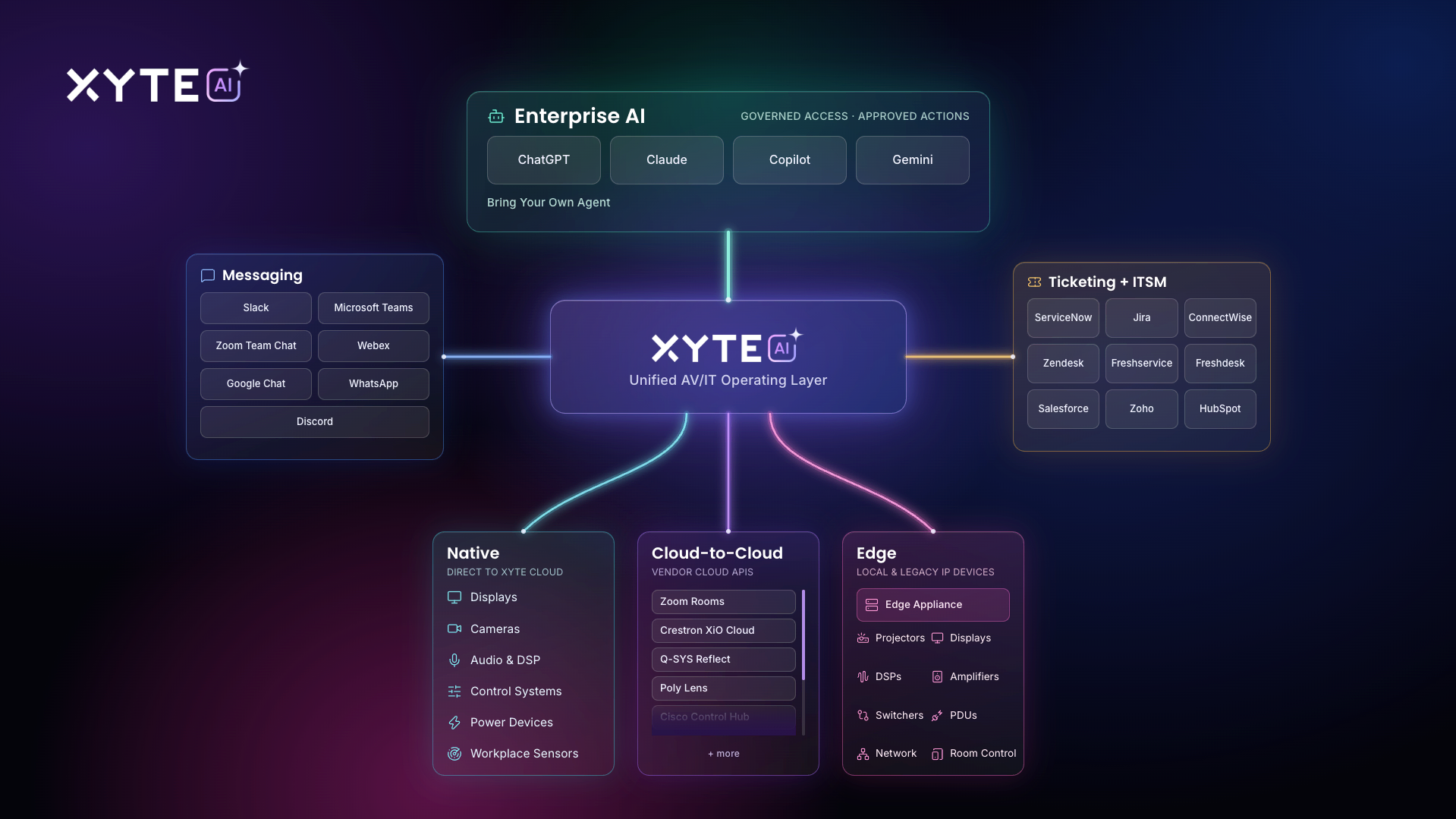
- Enterprises will standardize on vendor-agnostic operations layers. In 2026, the idea of a single pane of glass will stop being a preference and start becoming policy. Teams will use common tools and workflows that work across vendors, without locking them into a single ecosystem. That approach will make mixed fleets easier to manage and reduce the portal sprawl that slows down daily work.
- Room-level visibility becomes the operational baseline. In 2026, AV teams will manage at the room layer across multiple vendors, not at the individual device layer within isolated manufacturer portals. For example: a room’s "not working" pattern often isn’t one device, it’s a chain reaction after a firmware change, a config drift, and a UC update. To manage that complexity, teams need a single operational view of the room that brings together devices, configurations, recent changes, occupancy, and meeting signals across buildings, sites, and customer environments. That room-level context allows teams to explain why a room is degraded, rather than reacting to disconnected alerts from separate systems. This shift matters because multi-vendor environments are now the norm. Nearly half of Xyte’s active customers already manage devices from more than one manufacturer, with a growing share managing five, ten, or more vendors at once. In that reality, room-level insights—readiness, reliability trends, utilization, and lifecycle signals—only become actionable when data from different vendors can be combined without friction.
- OpenAV Cloud will move from industry initiative to operational expectation. Open, secure cloud APIs will stop being a nice-to-have in 2026. Customers will expect platforms to move data and workflows cleanly across vendors, with real interoperability as the baseline. OpenAV Cloud emerged in 2025 to help make that possible - an industry initiative focused on open, vendor-agnostic standards that has already brought together more than three dozen companies. As Richard Jonker from NETGEAR put it: “The future of AV is cloud-managed, software-defined, and built on open standards.”
- Collaboration across the value chain will stop being optional. Manufacturers, integrators, and enterprise teams need tighter alignment around shared outcomes like uptime, security, and support efficiency. In 2026, that kind of coordination will depend on neutral cloud layers - where data and insights can move where they’re needed, without breaking ecosystems or exposing what should stay protected.
The Bottom Line
Data-driven maturity has become the true benchmark for AV success - how well teams turn insight into consistent, reliable outcomes at scale. The teams making progress in 2026 will be the ones building systems that hold up under pressure, scale without chaos, and deliver steady value across every room and device.
This shift is already underway. I’m seeing more teams align around shared tools, stronger visibility, and platforms that support long-term performance. The focus now is on consistency - making sure AV works the way people need it to, day in and day out, across complex environments built on shared platforms and open foundations. That consistency depends on clear roles, steady coordination, and open cloud foundations that allow systems to work together without forcing lock-in.
What already defines AV leadership today, and will define it even more tomorrow, is the ability to deliver results that last, across more locations, with less friction. The teams that lead in 2026 will run AV like an operational system: room-first visibility, shared data, and support that gets better every day. Openness is what makes that possible at scale.
If you’re planning your 2026 AV-IT stack, explore the Xyte platform and see what modern operations look like when data and AV systems work together.