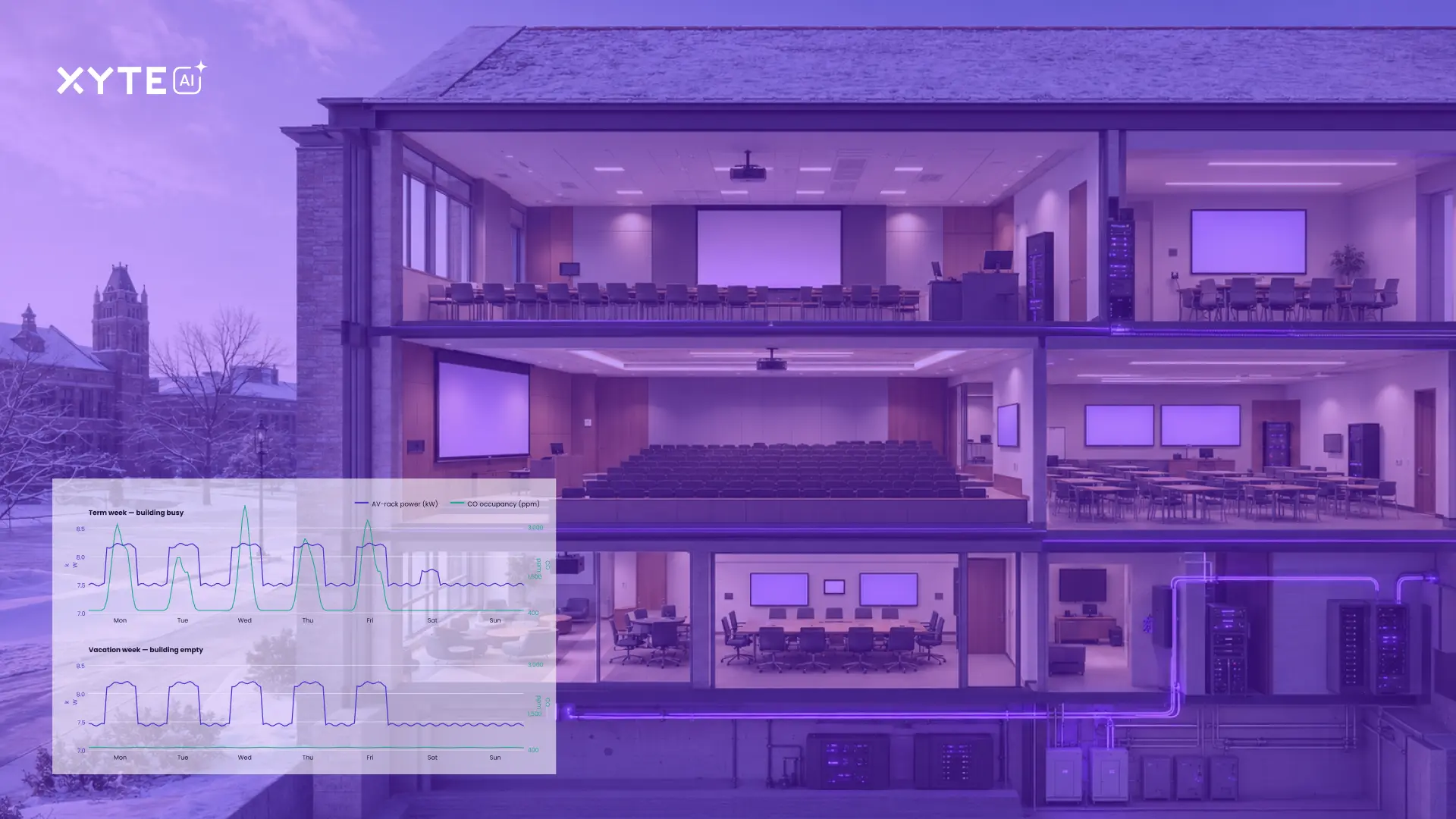
Room bookings. Occupancy. Temperature. Device health. Wi-Fi usage. AV telemetry.
Most workplaces already generate plenty of useful data. The problem is that it often sits in separate systems, owned by different teams and viewed through different portals.
That makes even basic questions harder than they should be.
Was the room booked, or was it actually used? Why does one area of the building sit empty every afternoon? Are users avoiding a space because of the room technology, the temperature, or something else?
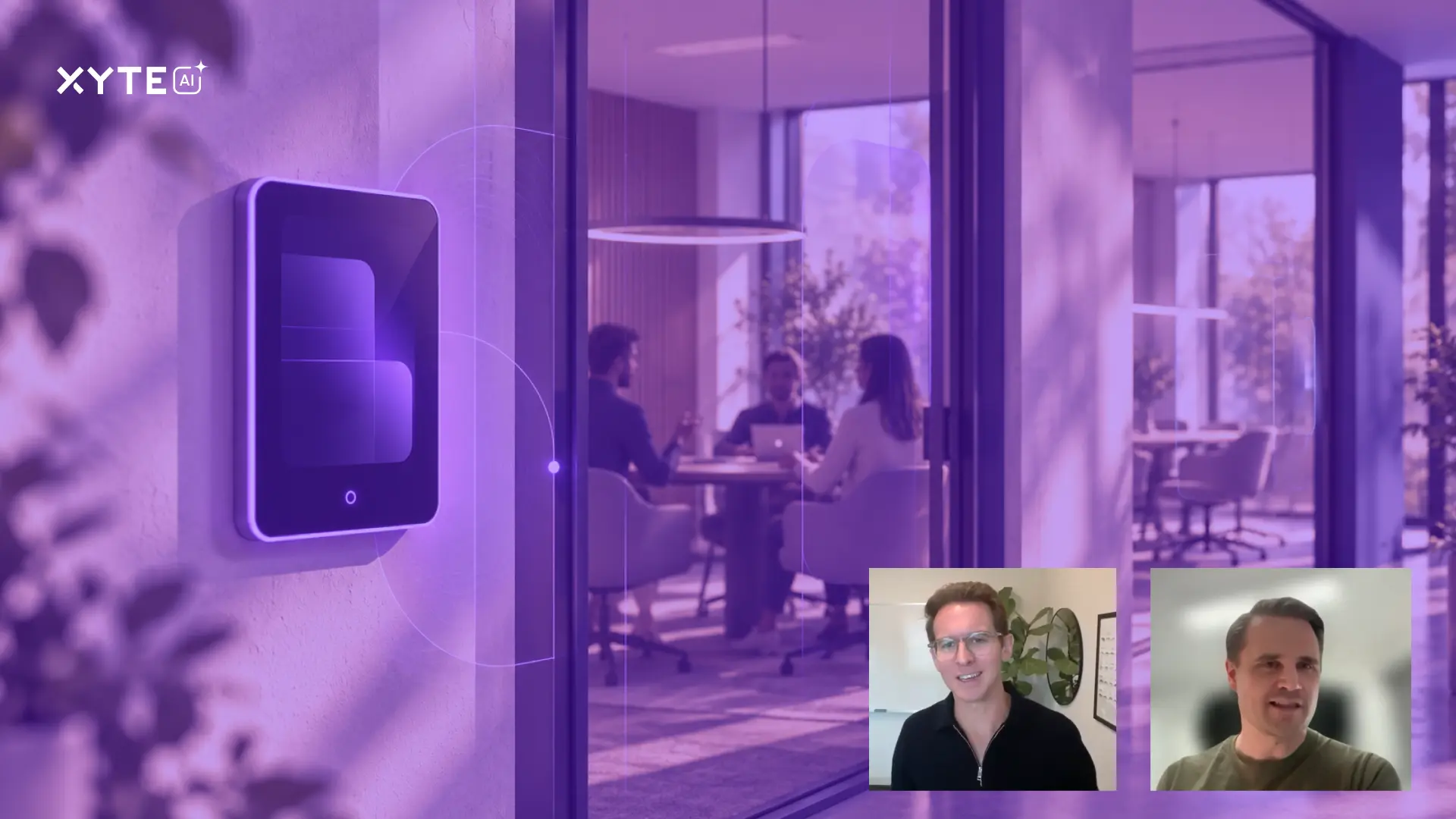
In a recent Xyte webinar, Humly CEO Anders Karlsson joined Xyte’s Andrew Gross to discuss how connected workplace data can help answer those questions, and where AI fits once the underlying systems can work together.
Watch the full webinar on demand
A booking tells you less than you think
A calendar can tell you whether a room was reserved. It can’t necessarily tell you whether anyone showed up.
Add a room panel with check-in data and you know more. Add occupancy sensing and you can see whether the room was actually used. Add other sensor data and you can start to understand how many people were there and what conditions were like while they were using it.
Anders described this as a layering process. Each additional source makes the picture more accurate and useful. A room might be booked 80 percent of the time but occupied only 60 percent. A room designed for eight people may regularly host only three. Those details can change how workplace teams think about space planning and support.
That is where workplace data starts to become operational rather than simply informational.
The harder problem is connecting the systems
Large workplaces rarely have one source of truth.
Booking systems may sit with workplace teams. AV platforms live with AV or IT. Facilities may already have temperature, energy, occupancy, and building-system data. Networking teams have another set of tools.
Anders noted that many customers already have half a dozen, sometimes a dozen, systems producing workplace-relevant data. The issue is that they tend to operate independently.
That separation creates blind spots.
A workplace team might see that a room is consistently unused. Facilities may know that part of the building runs warm in the afternoon. IT may know the room has recurring device issues. If those signals never meet, each team sees only part of the problem.
The first step is not necessarily adding another product. It is understanding what data already exists and finding ways to connect it.
Open architecture matters in a multi-vendor workplace
The real workplace is multi-vendor.
A single room may contain a Humly booking panel, a collaboration system, a display, audio equipment, a control system, sensors, and older devices that were never designed for cloud management.
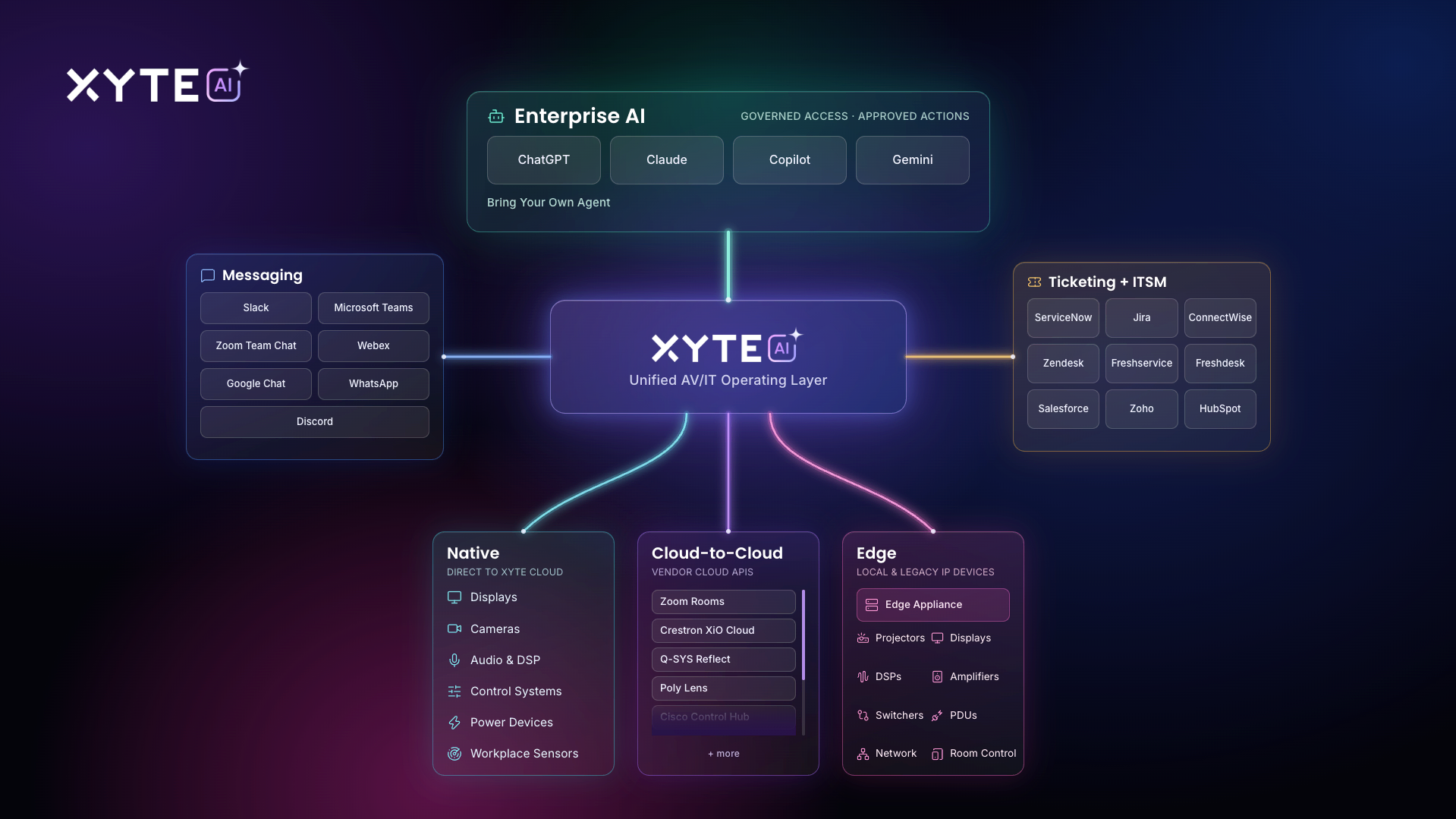
Xyte supports several ways to bring that technology into a common operational view. Humly connects natively to Xyte. Other systems can connect cloud-to-cloud, while legacy devices can be brought in through Xyte’s edge connectivity.
The goal is not to force every room onto the same hardware stack. It is to give teams one place to understand what is happening across the room, site, or fleet.
With Humly devices in Xyte, teams can see meeting activity, monitor device status, take remote actions such as rebooting a device, and bring in data such as CO2 and temperature when Humly sensing is deployed.
That means fewer isolated portals and more context around the spaces teams are responsible for keeping ready.
“What makes Xyte’s open platform really interesting is the openness, and the ability to bring your own AI.”
Anders Karlsson, CEO, Humly
Anders made that point while discussing another part of the architecture that matters more as AI moves into workplace operations: enterprises need control over which AI systems they use.
Humly works with large enterprises and public-sector organizations that may have strict rules about approved AI tools. In those environments, the answer is not to hard-wire workplace technology to one model or assistant. The better approach is to expose accurate data through open APIs, then allow the organization to connect the AI tools it has approved.
Better data gives AI something useful to work with
There is a lot of attention on workplace AI right now. But the model is only part of the equation.
If the underlying data is incomplete or disconnected, the answer will be too.
Anders put it plainly during the webinar: if you feed AI poor-quality data, you should not expect useful results. The more accurate the underlying data becomes, the more useful the insights can become.
This matters because AI is particularly well suited to finding relationships across data sets that are difficult for people to analyze manually.
Imagine trying to compare, over time:
- room bookings and actual occupancy
- desk and room utilization
- temperature and environmental conditions
- Wi-Fi usage
- energy consumption
- AV device health
- seasonal and day-of-week patterns
A person can spot a pattern in a small spreadsheet. It becomes much harder when hundreds of rooms, devices, and signals are involved.
Anders sees that pattern recognition as one of the practical roles for AI in workplace technology. The value comes when AI can work across those sources, find useful relationships, and help teams decide what to do next.
The goal is action, not another dashboard
More data by itself does not fix anything.
Anders gave a simple example during the webinar. Suppose one area of the third floor is regularly available in the afternoon. Booking data might tell you people are not using it. But combine that with environmental data and you may discover that the area gets too warm later in the day.
Now there is something a workplace or facilities team can investigate and address.
The same principle applies to AV and IT operations.
An offline device matters. A recurring device problem matters more. A recurring problem in a room with an important meeting scheduled soon matters even more.
Context helps teams decide what deserves attention first.
Over time, AI can help surface that context, identify patterns, recommend next steps, and support approved actions. The human team still sets the rules, permissions, and workflows.
Start by finding out what you already have
For teams trying to connect workplace technology, Anders offered practical advice: start with an inventory.
Find out which systems are already deployed across AV, IT, workplace, and facilities. Understand what data they produce. Identify which systems can already communicate through APIs, cloud connections, or local integrations.
Then look at the questions your teams actually need to answer.
You may already have much of the data required to understand your rooms and spaces better. The next step is making that data work together.
Watch the full Humly + Xyte conversation
Hear Anders Karlsson and Andrew Gross discuss multi-vendor workplace technology, connected data, open architecture, AI, and what teams can do with these systems today.
Watch “Beyond the Single-Vendor Workplace: Connecting Devices, Data and AI” on demand.